THE BANK OF KOREA MEASURED IT — REACH FOR A DOLLAR TOKEN AND YOUR OWN MONEY FALLS — THE LADDER TO HARDER MONEY HAS ONE MORE RUNG
The bank measured the direction of the flow. It only runs one way — toward the harder money.
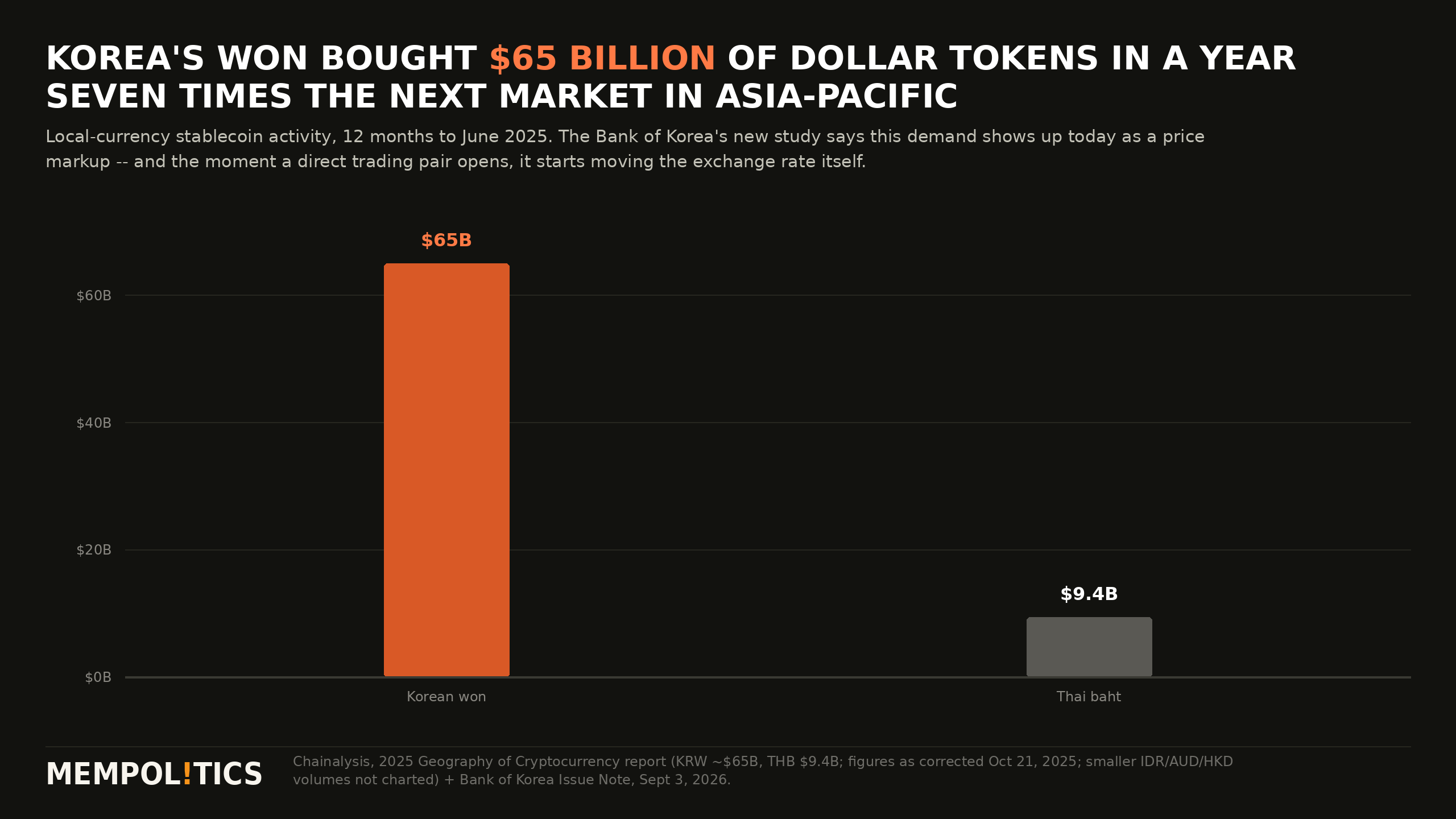
The Bank of Korea’s researchers asked a simple question: what happens to a country’s money when its people can buy dollar tokens directly? They used Binance’s own listings as the experiment. Before a currency gets a direct pair with dollar stablecoins, the demand for dollars just shows up as a markup — people pay extra for the token, and the exchange rate barely moves. After the pair opens, the dam breaks. The firms selling the tokens balance their books by selling the local currency for real dollars, and the study found the local money falls — in the bank’s own words, higher token premiums come with “significant local currency depreciation.” Korea has no such pair yet, so Korean demand piles up as a markup instead: about $64 billion of stablecoins bought with won in a single year, the most of any local currency in Asia-Pacific. Read what this is. A central bank documented, with its own math, that when people get a door to harder money, they walk through it — and the money they leave behind gets lighter. The dollar is the first rung of that ladder. But the dollar is also somebody’s local money, managed by a committee, its supply set by decree. The same flow the bank measured draining the won and the real toward the dollar is the flow the Fundamentalist expects to keep climbing — out of every money that can be printed, toward the one that cannot. The bank’s answer is to regulate the door and strengthen the won. The door doesn’t argue. It just counts the people walking through.
KEY RECEIPTS
The study: “Stablecoin–FX Linkages,” Bank of Korea Issue Note, Jihyun Kim and Sangheum Cho, International Department, posted Sept 3 (the primary).
The bank’s words, verbatim: after a pair opens, “higher premia are associated with significant local currency depreciation,” and buying pressure is “significantly associated with depreciation of the paired currencies.”
The experiment: Binance’s fiat–stablecoin pair listings, 2019–2025 — the market makers supplying tokens hedge by selling the local currency for dollars in the FX market.
The control case: Korea has no won pair on the exchange, so buying pressure there shows up as a higher token markup and no measured move in the exchange rate.
Korea’s scale: about $64 billion of stablecoins bought with won in the 12 months to June 2025 — roughly seven times Thailand’s $9.4 billion, the next Asia-Pacific market (Chainalysis, figures as corrected Oct 2025).
The bank’s policy answer: regulate digital assets while internationalizing the won and deepening FX liquidity “to strengthen the market’s capacity to absorb shocks.”
Who profits: nobody is selling anything here — a central bank publishing inconvenient math about its neighbors’ money and its own.
Coverage first reported by CoinDesk this afternoon.
At the time of this writing, bitcoin was $80,059 (Crypto.com, 1:00 PM ET, Sep 5).
The bank’s words, verbatim: after a pair opens, “higher premia are associated with significant local currency depreciation,” and buying pressure is “significantly associated with depreciation of the paired currencies.”
The experiment: Binance’s fiat–stablecoin pair listings, 2019–2025 — the market makers supplying tokens hedge by selling the local currency for dollars in the FX market.
The control case: Korea has no won pair on the exchange, so buying pressure there shows up as a higher token markup and no measured move in the exchange rate.
Korea’s scale: about $64 billion of stablecoins bought with won in the 12 months to June 2025 — roughly seven times Thailand’s $9.4 billion, the next Asia-Pacific market (Chainalysis, figures as corrected Oct 2025).
The bank’s policy answer: regulate digital assets while internationalizing the won and deepening FX liquidity “to strengthen the market’s capacity to absorb shocks.”
Who profits: nobody is selling anything here — a central bank publishing inconvenient math about its neighbors’ money and its own.
Coverage first reported by CoinDesk this afternoon.
At the time of this writing, bitcoin was $80,059 (Crypto.com, 1:00 PM ET, Sep 5).
EVERY LADDER TO HARDER MONEY ENDS AT THE SAME TOP RUNG.
THE CAP IS STILL TWENTY-ONE MILLION.
THE CAP IS STILL TWENTY-ONE MILLION.
Bank of Korea Issue Note (primary) + Chainalysis + CoinDesk · Sat Sep 5 2026 · 1:25 PM ET